Introduction
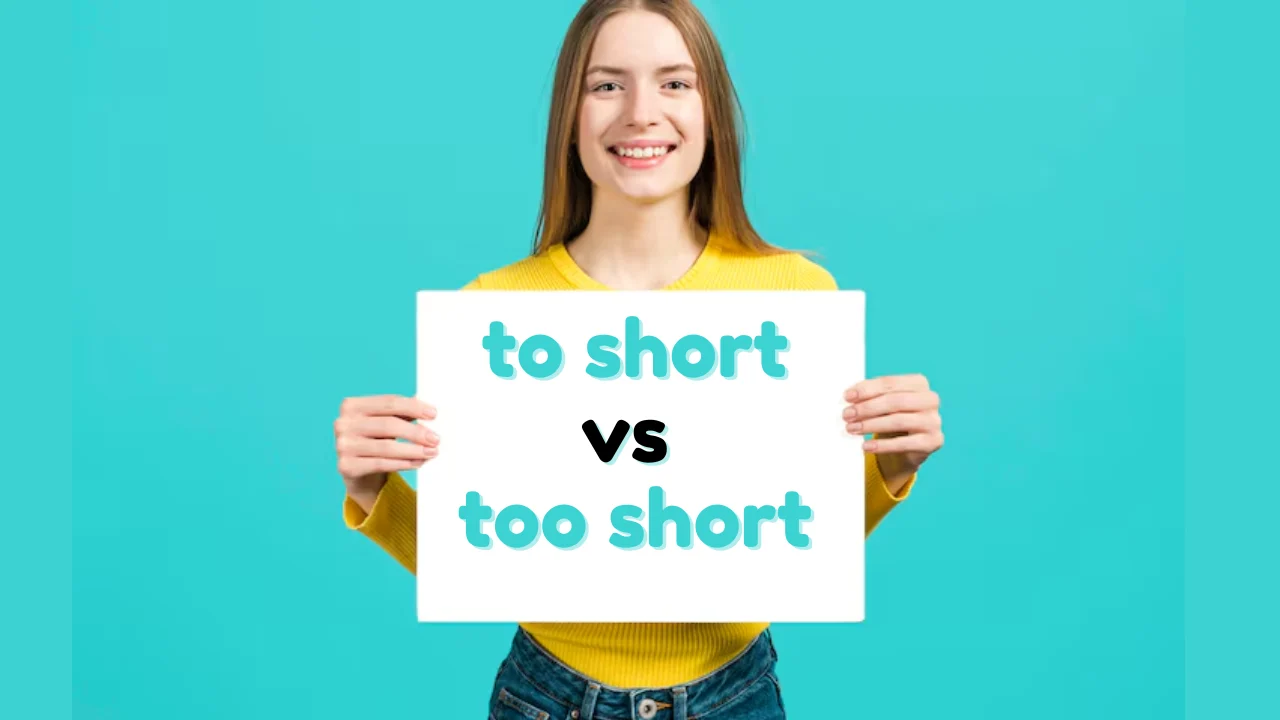
Have you ever paused while writing and wondered whether it should be to short or too short? You’re not alone. This is a very common English mistake, especially because to and too sound exactly the same when spoken.
The confusion usually happens in quick writing texts, emails, captions, or even professional content—where one small extra “o” can completely change correctness. While one phrase is perfectly correct and widely used, the other is simply wrong in standard English.
Although they sound similar, they serve completely different purposes.
In this detailed guide, we’ll clearly explain too short vs to short, why only one is correct, how to and too actually work, real-life conversation examples, a comparison table, and easy memory tricks so you never make this mistake again.
What Is Too Short?
Meaning of Too Short
Too short is the correct and grammatically valid phrase.
- Too is an adverb
- It means excessively, more than necessary, or more than acceptable
- Short is an adjective describing length, height, or duration
Together, too short means shorter than what is acceptable or expected.
How too short is used
You use too short when something:
- Is insufficient in length
- Does not meet a requirement
- Causes a problem because of its shortness
Examples:
- This dress is too short.
- The meeting was too short to cover everything.
- His explanation was too short to be helpful.
- The deadline is too short for such a big project.
Grammatical role
- Too (adverb) modifies short
- Common structure: too + adjective
Why this works
In English, too often means more than needed:
- Too hot
- Too loud
- Too expensive
- Too short
✅ Key rule:
If you mean excessively or more than acceptable, always use too short.
What Is To Short?
Meaning of To Short
To short is not grammatically correct in standard English.
- To is usually:
- A preposition (to the store)
- Part of an infinitive (to run, to eat)
But to cannot directly modify an adjective like short.
Why people write to short
This mistake happens because:
- To and too sound the same
- Writers type quickly
- The rule feels subtle in spoken English
Incorrect examples:
- ❌ This skirt is to short.
- ❌ The video was to short.
- ❌ The rope is to short.
All of these are incorrect and should use too instead.
🚫 Important:
If you see to short, it’s almost always a spelling or grammar mistake.
Key Differences Between Too Short and To Short
| Feature | Too Short | To Short |
|---|---|---|
| Grammatically correct | ✅ Yes | ❌ No |
| Common usage | Very common | Incorrect |
| Part of speech | Adverb + adjective | Invalid structure |
| Meaning | Excessively short | None |
| Accepted in writing | All contexts | Never |
🎯 Quick takeaway:
- Too short = correct
- To short = incorrect
Real-Life Conversation Examples
🗣️ Dialogue 1: Shopping
Friend: I like this dress, but it’s to short.
You: You mean too short—with two o’s.
Friend: Right! It’s definitely too short.
🎯 Lesson: Use too before adjectives.
🗣️ Dialogue 2: At Work
Manager: The report is too short.
Employee: Should I add more details?
Manager: Yes, it needs more depth.
🎯 Lesson: Too short signals a problem or lack.
🗣️ Dialogue 3: School Assignment
Student: My essay is to short.
Teacher: It should be too short remember, too means excessive.
Student: Got it!
🎯 Lesson: Grammar rules matter in academic writing.
🗣️ Dialogue 4: Casual Chat
Friend: The movie felt too short.
You: I agree—it ended so quickly.
🎯 Lesson: Too short works naturally in conversation.
When to Use Too Short
✅ Use too short when:
- Something is insufficient in length
- There’s a negative or limiting effect
- You could replace too with excessively
Examples:
- Too short to explain
- Too short for the job
- Too short to matter
- Too short to be useful
When Can To + Short Ever Be Correct?
Technically, to short could appear only in very rare, specialized contexts, such as:
- Technical or financial jargon (e.g., to short a stock)
Example:
- He decided to short the stock.
⚠️ Important:
- In this case, short is a verb, not an adjective
- This meaning is completely different from describing length
For everyday writing and descriptions, to short = incorrect.
Common Mistakes to Avoid
❌ “The skirt is to short.”
✔️ “The skirt is too short.”
❌ “The time was to short.”
✔️ “The time was too short.”
❌ Using to instead of too before adjectives
✔️ Use too for emphasis or excess
Fun Facts & Memory Tricks
🧠 Memory Trick #1
Too has too many O’s → it means too much 😄
🧠 Memory Trick #2
If you can replace the word with very, too is correct:
- Very short ✅
- Too short ✅
📜 Fun Fact
English uses to, too, and two as homophones—three different meanings, one sound. That’s why spelling mistakes like to short are so common.
Conclusion
The difference between too short and to short is simple once you understand the role of too. Too short is the correct phrase used to describe something that is excessively or insufficiently short. To short, in normal descriptive writing, is simply incorrect.
Remember:
- Too = excessive
- Short = adjective
- Together = too short
Next time you’re writing and hesitate between to short and too short, you’ll know exactly which one to choose! ✅