
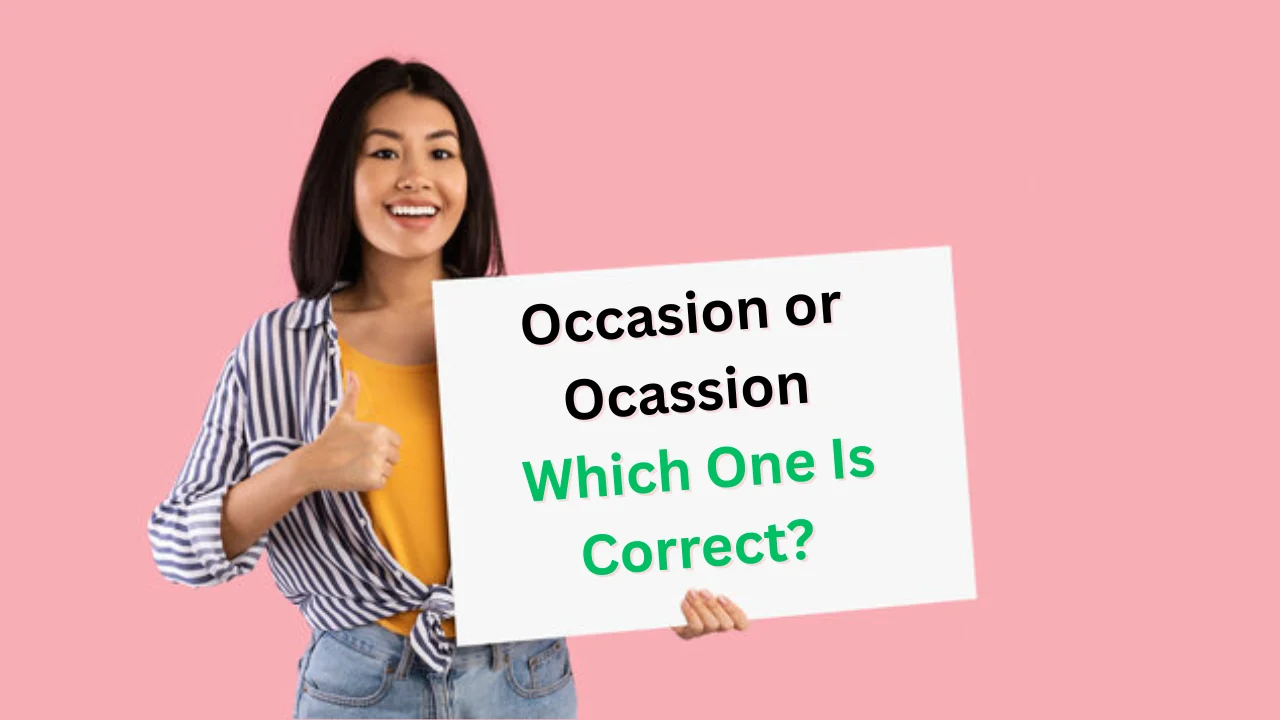
Have you ever paused mid-sentence, wondering whether to write “occasion” or “ocassion”? 📝 You’re not alone! This is one of those English spelling traps that even fluent writers fall into — especially when typing quickly or relying on instinct.
Both versions look right at a glance, but only one of them is correct.
Although “occasion” and “ocassion” sound identical, they don’t share the same spelling credibility.
In this guide, we’ll break down which form is grammatically correct, why the other is a common mistake, and how to remember the right one forever. By the end, you’ll never second-guess yourself when writing about birthdays, weddings, or any other special occasion! 🎉
What Is “Occasion”?
✅ “Occasion” is the correct and officially recognized spelling in English.
It’s a noun meaning a particular event, time, or reason when something happens. It can also be used as a verb, meaning to cause or bring about something.
Meaning and Usage
Occasion (noun):
A specific event or moment that is noteworthy or special.
Examples:
- “The wedding was a joyful occasion.”
- “She wore her best dress for the occasion.”
- “On rare occasions, he visits his hometown.”
Occasion (verb):
To cause something or make it happen.
Examples:
- “His comments occasioned a strong reaction.”
- “The mistake occasioned confusion among the team.”
Word Origin
The word “occasion” comes from the Latin “occasio,” meaning a falling toward, opportunity, or happening.
It entered English through Old French in the 14th century and has kept its double “s” pattern ever since.
💡 In short: “Occasion” is the only correct and standard spelling accepted in British, American, Canadian, and Australian English.
What Is “Ocassion”?
⚠️ “Ocassion” is an incorrect spelling of the word occasion.
It’s a common misspelling caused by the assumption that the middle sound “shaun” should be represented by a double “s” (like possession or passion). However, in occasion, the double letter is ‘c,’ not ‘s’.
Why People Make This Mistake
- Phonetic confusion: The soft “sh” sound in “occasion” makes people think it needs a double “s.”
- Typing errors: Fast typing or autocorrect slips often lead to “ocassion.”
- Pattern mixing: Words like session or mission mislead people into assuming “occasion” follows the same rule.
Examples of Incorrect Usage (❌)
- “It was a special ocassion for the family.” ❌
- “We met on several ocassions last year.” ❌
👉 These sentences should be written as:
- “It was a special occasion for the family.” ✅
- “We met on several occasions last year.” ✅
Key Differences Between “Occasion” and “Ocassion”
| Feature | Occasion | Ocassion |
|---|---|---|
| Correctness | ✅ Correct spelling | ❌ Incorrect spelling |
| Usage | All forms of English | None (error) |
| Part of Speech | Noun / Verb | – |
| Meaning | An event or reason | – |
| Examples | “A happy occasion.” | “A happy ocassion.” (wrong) |
💡 Quick Trick to Remember:
👉 Double the “C,” not the “S.”
OCCASION = CC + SION.
Real-Life Conversation Examples
Dialogue 1: Writing an Invitation
Sophie: “Is it ‘ocassion’ or ‘occasion’ for the birthday card?”
Liam: “Always double the C — it’s ‘occasion’.”
🎯 Lesson: The correct spelling for all events is occasion with double “C.”
Dialogue 2: Office Email Draft
Priya: “Did I spell ‘ocassion’ right in the subject line?”
James: “Not quite — it’s ‘occasion’ with two C’s. Grammarly caught it!”
🎯 Lesson: Even tools can help, but learning the rule is better.
Dialogue 3: Teacher and Student
Student: “Why does ‘occasion’ have two C’s?”
Teacher: “Because it comes from Latin ‘occasio’ — the root has two C’s.”
🎯 Lesson: The double “C” comes from the original Latin spelling.
Dialogue 4: Texting Friends
Emma: “I’m saving this outfit for a special ocassion 😅.”
Ava: “You mean occasion! Grammar police alert!”
🎯 Lesson: Only occasion is correct — even autocorrect can’t always save you!
Dialogue 5: Marketing Brainstorm
Tom: “Should we print ‘Perfect for Every Ocassion’ on our flyers?”
Sarah: “Yikes — better fix that! It’s ‘Occasion.’ One wrong letter can hurt our brand.”
🎯 Lesson: Spelling errors can affect credibility in professional settings.
When to Use “Occasion” vs “Ocassion”
| Context | Occasion | Ocassion |
|---|---|---|
| Academic Writing | ✅ | ❌ |
| Invitations & Cards | ✅ | ❌ |
| Professional Documents | ✅ | ❌ |
| Social Media Posts | ✅ | ❌ |
| Spoken English | Same pronunciation | Same pronunciation |
👉 Bottom Line:
Use occasion — always.
Never use ocassion, even in informal writing or texting.
Fun Fact or History Section
Did you know? 🎓
The word “occasion” has been used in English since the 1300s, originally meaning a cause or reason. The “event” sense we use today didn’t appear until the 1500s.
Also interesting: The double “C” in “occasion” reflects the Latin ob + cadere, meaning to fall toward — the same root that gives us “accident” and “coincidence.”
So when you double that “C,” you’re actually staying true to ancient Latin roots! 💬
Conclusion
To wrap up: “Occasion” is the correct spelling — used and accepted everywhere in English.
“Ocassion” is simply a typo or misunderstanding of English spelling patterns.
Remember the golden rule: Double the C, not the S!
So next time you write about a wedding, meeting, or party, confidently spell it O-C-C-A-S-I-O-N.
🎉 Whether it’s a happy, rare, or special occasion, now you’ll always spell it right!