Introduction
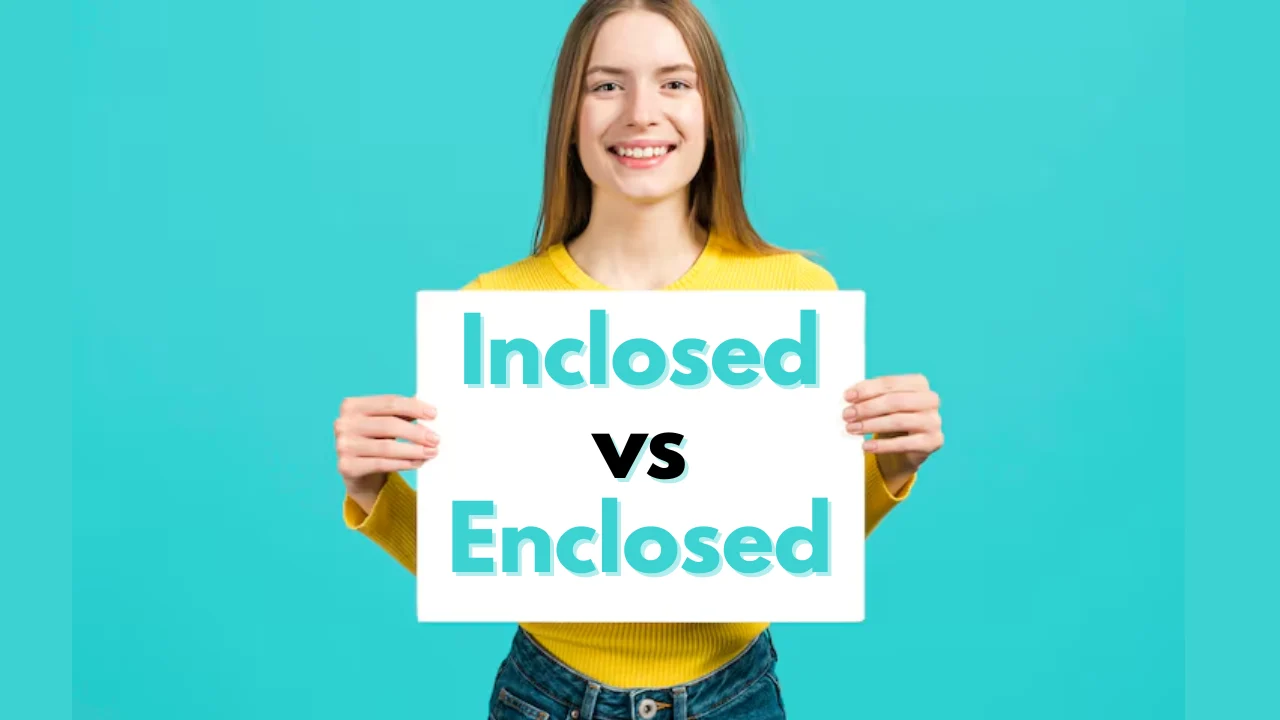
“Inclosed” and “enclosed” are two spellings that confuse many English learners because they look so similar and seem like they should mean the same thing. You might find both versions in old documents, handwritten notes, or historical texts — which only adds to the confusion.
Although they sound alike, only one of these spellings is considered correct in modern English, especially in professional, legal, and business communication. Understanding the difference helps you write confidently in emails, formal letters, instructions, and any content where clarity matters.
In this article, you’ll learn the definitions, correct usage, examples, comparison table, dialogues, and easy memory tricks to ensure you never mix these two spellings again.
What Is “Enclosed”? (Correct Spelling)
Enclosed is the modern and correct spelling. It means something is surrounded, included, or placed inside something else.
Meaning:
- Contained within something
- Surrounded or completely covered
- Attached or included (in letters or emails)
Examples:
- “Please find the document enclosed with this email.”
- “They live in an enclosed community.”
- “The garden is enclosed by a wooden fence.”
Where It’s Used:
- Emails and letters
- Legal documents
- Construction and property descriptions
- Packaging and mailing
Tip: Enclosed = placed inside or surrounded.
What Is “Inclosed”? (Old/Incorrect Spelling)
Inclosed is an archaic (old-fashioned) spelling that is not used in modern English. You may find it in historical texts, literature from the 1800s, or very old handwritten letters.
Meaning:
- Same meaning as “enclosed,” but outdated
- Not acceptable in modern writing
Examples (Historical Only):
- “The field was inclosed by stone walls.” (found in old books)
- “The letter is inclosed herein.” (old legal English)
Where It Appears:
- Historical texts
- Old English documents
- Rare or stylistic uses
Tip: Inclosed = old spelling. Avoid in modern writing.
Key Differences Between Inclosed and Enclosed
| Feature | Enclosed | Inclosed |
|---|---|---|
| Spelling Status | Correct, modern | Archaic, outdated |
| Usage | Emails, letters, documents, packaging | Old writing only |
| Meaning | Surrounded, contained, included | Same meaning, but no longer used |
| Professional Use | ✔ Accepted | ❌ Incorrect |
| Examples | “Enclosed documents” | “Inclosed documents” (historical) |
Quick Summary:
- Enclosed = correct
- Inclosed = outdated / old spelling
Real-Life Conversation Examples
Dialogue 1
Aiman: I wrote “Please see the files inclosed.” Is that correct?
Ramzan: Not really. The correct spelling is enclosed.
🎯 Lesson: Always use “enclosed” in emails.
Dialogue 2
Sara: I found “inclosed” in an old novel.
Leo: Yes, it’s an old spelling. Modern English uses enclosed.
🎯 Lesson: “Inclosed” appears only in historic writing.
Dialogue 3
Usman: Should I say “enclosed area” or “inclosed area”?
Hiba: “Enclosed area” — it’s the modern and correct form.
🎯 Lesson: Use “enclosed” for spaces surrounded by walls or fences.
Dialogue 4
Chef Ali: The recipe card is inclosed in the box.
Chef John: It should be “enclosed.”
🎯 Lesson: “Enclosed” is standard for packaging.
When to Use Enclosed vs Inclosed
✔️ Use enclosed when:
- Sending business or formal emails
- Talking about items that are included or attached
- Describing fenced or surrounded spaces
- Writing for modern audiences
❌ Avoid inclosed unless:
- You’re quoting from old books
- You’re analyzing historical documents
- You intentionally want an archaic style
Memory Tricks
✨ Enclosed = Enter modern English
✨ Inclosed = In the past
Or simply:
➡️ E = Everyday modern usage
➡️ I = Irrelevant today
Fun Fact
Before standardized spelling, both “inclose” and “enclose” were used. By the early 1900s, “enclose” became the official and widely accepted spelling in dictionaries, schools, and formal writing.
Conclusion
While “inclosed” and “enclosed” once shared the same meaning, only enclosed is correct and acceptable in modern English. Whether you’re sending an email, attaching documents, writing instructions, or describing a fenced area, enclosed is the spelling you should always use. “Inclosed” belongs to historical English and should be avoided unless you’re quoting old texts. Now you’ll never hesitate when choosing between the two — enclosed is the modern, professional, and correct choice.